

What is Laser-Assisted Hatching?
Laser-Assisted Hatching (LAH) is an advanced laboratory technique used during In-Vitro Fertilisation (IVF) to help an embryo break through its outer protective layer before implantation.
Each embryo is surrounded by a thin outer shell called the zona pellucida. Before an embryo can implant into the uterus, it must naturally “hatch” from this shell.
In some cases, the zona pellucida may be thicker or harder, making it more difficult for the embryo to hatch.
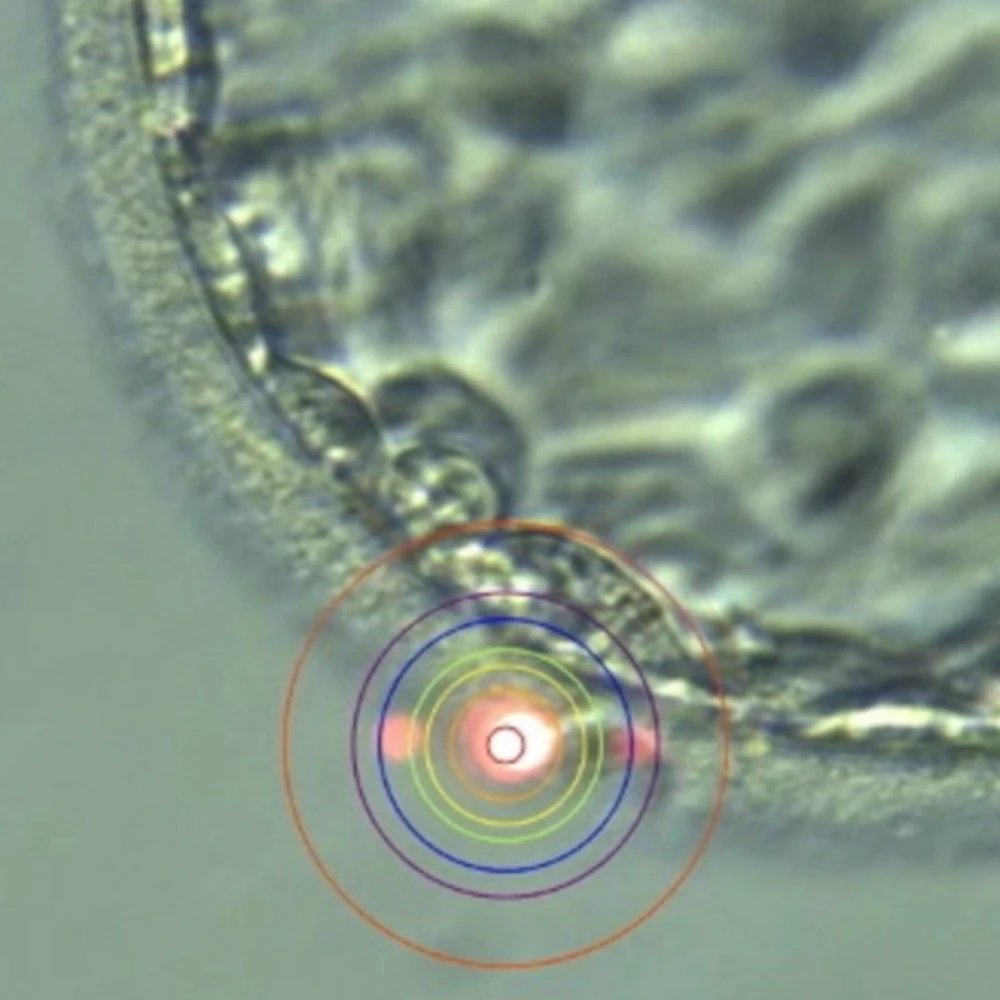
At Sunfert, we may perform Laser-Assisted Hatching by using a highly precise medical laser to create a tiny opening in the zona pellucida. This can assist the embryo in hatching and improve the chances of implantation in selected patients.
Our embryology team carefully evaluates each embryo to determine whether Laser-Assisted Hatching is necessary before proceeding with the procedure.
Who Can Benefit from Laser-Assisted Hatching?
Laser-Assisted Hatching may benefit certain patients undergoing IVF who have factors that could affect the embryo’s ability to hatch and implant.
At Sunfert, we may consider Laser-Assisted Hatching for patients who have:
- previous failed IVF cycles
- advanced maternal age
- embryos with a thicker zona pellucida
- limited number of embryos available for transfer
- frozen embryo transfer cycles
In these situations, Laser-Assisted Hatching may help the embryo hatch from its outer shell more easily, which may improve its ability to attach to the uterine lining.
However, it is important to note that Laser-Assisted Hatching is not necessary for all IVF patients. Our embryology team will recommend it only when there is clinical evidence that it may improve the likelihood of implantation.
How is Laser-Assisted Hatching Performed at Sunfert?
Step 1: Embryo Development
After fertilisation, embryos are cultured in the laboratory for several days while their development is carefully monitored.
Step 2: Embryo Assessment
Our embryologists evaluate the embryo quality and the thickness of the zona pellucida.
Step 3: Performing Laser-Assisted Hatching
A highly precise laser beam will be used to create a small opening in the outer shell of the embryo.
Laser-Assisted Hatching is performed shortly before the embryo transfer procedure. It can be applied to embryos at the early cleavage stage (typically 2 to 3 days after egg retrieval) or at the blastocyst stage (usually 5 to 6 days after egg retrieval).
Step 4: Embryo Transfer
The embryo is then ready for transfer into the uterus.
Take the Next Step with Our Fertility Specialists
If you are facing fertility challenges, start with a consultation at Sunfert. We will guide you through your fertility journey with expertise and compassionate care.
Make an appointment with our Fertility Specialist today and take the next step toward your parenthood goals.
Frequently Asked Questions About Laser-Assisted Hatching
Question #1: Does Sunfert charge extra for performing Laser-Assisted Hatching?
- No. At Sunfert, Laser-Assisted Hatching is included as part of our IVF treatment for embryos that may face challenges with hatching. We do not require our patients to pay extra for it.
Question #2: Does Laser-Assisted Hatching increase IVF success rates?
- Laser-Assisted Hatching is used to create a small opening in the embryo’s outer layer to provide a little assistance for the embryo to hatch so we can improve implantation rates for our patients, particularly those with a history of previous IVF failure.
Question #3: Is Laser-Assisted Hatching safe for embryos?
- Laser-Assisted Hatching is a safe technique and an assisted reproductive technology.
- At Sunfert, our embryologists are all equipped with a strong skillset for performing Laser-Assisted Hatching.
Question #4: Is Laser-Assisted Hatching done before embryo transfer?
- Yes. The procedure is performed in the laboratory shortly before the embryo is transferred into the uterus.
Question #5: Does Laser-Assisted Hatching guarantee pregnancy?
- No fertility treatment can guarantee pregnancy. Laser-Assisted Hatching is one of several standard laboratory techniques that support implantation in selected cases.