

What is Embryo Freezing?
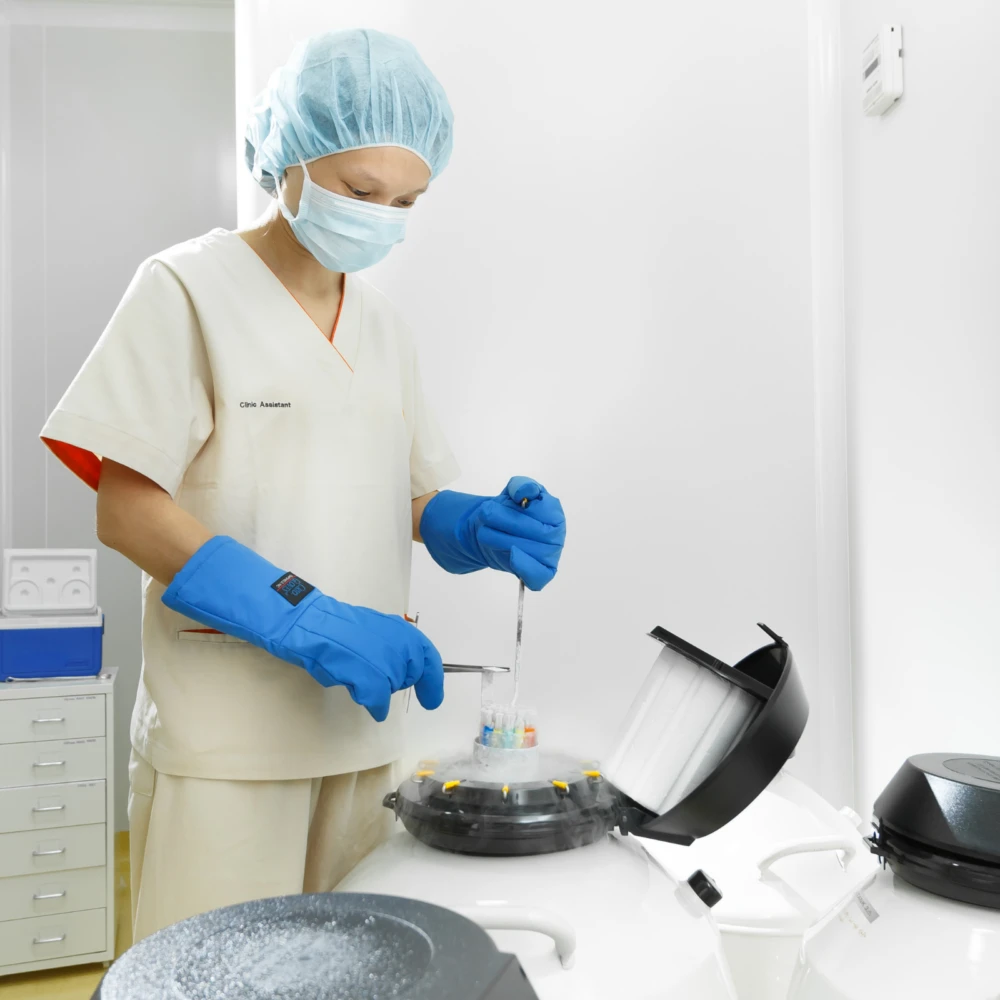
Also known as Embryo Cryopreservation, is a laboratory technique used to preserve embryos created through IVF (In-Vitro Fertilisation) for future pregnancy attempts.
In simple terms:
- eggs are fertilised with sperm in the laboratory.
- which later developed into embryos.
- will be frozen using the vitrification method.
- the frozen embryos can later be thawed and transferred into the uterus.
Today, at Sunfert we use a rapid freezing method called vitrification, which:
- minimises ice crystal formation
- protects embryo quality by keeping them at –196°C
- maintains high survival rates after thawing
Embryo freezing plays a key role in improving cumulative IVF success rates, reducing the need for repeated ovarian stimulation cycles.
Who Should Consider Embryo Freezing?
Embryo freezing is suitable for:
1. Couples Undergoing IVF
- More good-quality embryos remain after a fresh embryo transfer
- Desire to plan future pregnancies without repeating the full IVF cycle
2. Patients with Medical Conditions
- Undergoing chemotherapy or radiotherapy
- Facing medical treatments that may affect fertility
3. Those at Risk of Ovarian Hyperstimulation Syndrome (OHSS)
- Embryos may be frozen to allow the body to recover before transfer
4. Individuals Planning Delayed Parenthood
- Wish to preserve embryos while fertility potential is optimal
At Sunfert, we provide personalised fertility assessments to determine whether embryo freezing supports long-term reproductive goals.
How is Embryo Freezing Performed at Sunfert?
At Sunfert, embryo freezing can be done within 6 steps:
Step 1: Fertility Evaluation
During a fertility assessment, we conduct a comprehensive evaluation for both partners to identify potential factors affecting fertility and guide a personalised treatment plan.
- Both Partners: Review of medical history, reproductive history, and previous fertility treatment outcomes.
- Female Partner: Hormonal profile testing, ovarian reserve assessment, and evaluation of the pelvic organs (uterus, ovaries, cervix, fallopian tubes).
- Male Partner: Semen analysis to assess sperm quality and reproductive potential.
Step 2: Ovulation Stimulation
Hormonal medications will be given by our doctors which used to stimulate the ovaries to produce multiple eggs.
This stage usually starts at Day 2 or Day 3 of the patient’s menstrual cycle and typically lasts about 10 to 12 days depending on the treatment protocol the patient undergoes.
Step 3: Oocyte Pick-Up (OPU)
Also known as egg retrieval, this is a minimally invasive procedure in which our fertility specialist collects eggs from the patient’s ovaries. The procedure typically takes about 20 to 30 minutes to complete.
During OPU, patients are given light anaesthesia or monitored sedation by an anaesthetist, ensuring that they remain comfortable and pain-free throughout the procedure.
Before concluding the procedure, our fertility specialist will carefully examine the vaginal puncture site to ensure there is no bleeding.
After OPU, patients are observed for 1 to 2 hours in our day ward before being discharged home.
Most patients experience only mild bloating, cramping, or minimal bleeding, and many are able to return to their normal routine the next day.
Step 4: Fertilisation in the Lab
The collected eggs are fertilised with the husband’s or a donor’s sperm using IVF, forming embryos that are then cultured and carefully monitored in our advanced incubators.
Step 5: Embryo Freezing and Storage
The embryos will then be frozen and stored in our laboratory using vitrification, a rapid freezing technique that preserves viability.
Step 6: Future Frozen Embryo Transfer (FET)
When ready, a frozen embryo can be thawed and transferred into the uterus to help achieve pregnancy.
Take the Next Step with Our Fertility Specialists
If you are facing fertility challenges or considering embryo freezing for future family planning, start with a consultation at Sunfert. We will guide you through your fertility journey with expertise and compassionate care.
Make an appointment with our Fertility Specialist today and take the next step toward your parenthood goals.
-
 Book a consultation
Dato' Dr Wong Pak Seng
Founder of Sunfert Group & Fertility Specialist- Sunfert@Bangsar South
-
 Book a consultation
Dr Eeson Sinthamoney
Group Medical Director & Fertility Specialist- Sunfert@Bangsar South
-
 Book a consultation
Dr Lim Lei Jun
Medical Director (Sunfert Bangsar South) & Fertility Specialist- Sunfert@Bangsar South
-
 Book a consultation
Dr Sumithra Devi Valiapan
Consultant Obstetrician, Gynaecologist & Fertility Specialist- Sunfert@Bangsar South
-
 Book a consultation
Dr Haris Njoo Suharjono
Medical Director (Sunfert Kuching) & Fertility Specialist- Sunfert@Kuching
-
 Book a consultation
Dr Evelyn Pang Mei Foong
Obstetrics, Gynaecology & Fertility Specialist- Sunfert@Seremban
-
 Book a consultation
Dr Chong Jie Wen
Consultant Obstetrician, Gynaecologist & Fertility Specialist (Sessional)- Sunfert@Ipoh
-
 Book a consultation
Dr Rohani Binti Effendy
Consultant Obstetrician, Gynaecologist & Fertility Specialist (Sessional)- Sunfert@Bangsar South
What is embryo freezing in IVF treatment?
Embryo freezing, also known as embryo cryopreservation, is a laboratory process where embryos created through IVF are preserved for future use.
After fertilisation, embryos are developed in the lab and then frozen at –196°C using a method called vitrification.
This allows patients to use the embryos at a later stage when they are ready for pregnancy.
What are the benefits of embryo freezing?
Embryo freezing allows fertility preservation, better cycle planning, and improved cumulative pregnancy chances.
It also supports patients who need medical treatment or wish to delay pregnancy while preserving high-quality embryos for future use.
Who should consider embryo freezing?
Embryo freezing is suitable for couples undergoing IVF with surplus good-quality embryos, patients undergoing medical treatments such as chemotherapy, individuals at risk of Ovarian Hyperstimulation Syndrome (OHSS), and those planning to delay pregnancy.
At Sunfert, our fertility specialist will recommend couples based on their fertility conditions and treatment plan.
Does embryo freezing improve IVF success rates?
Embryo freezing can improve cumulative IVF success rates by allowing multiple transfer attempts from a single egg retrieval cycle.
This reduces the need for repeated ovarian stimulation and provides flexibility in planning pregnancy.
Is embryo freezing part of IVF treatment?
Yes, embryo freezing is often an integral part of IVF.
After fertilisation, any suitable embryos can be frozen for future use instead of being transferred immediately.
This helps maximise the chances of pregnancy across multiple treatment cycles.
Does freezing damage embryos?
With advanced vitrification techniques, embryo damage is extremely rare.
The process is designed to protect cellular structure, and most embryos survive the thawing process with their developmental potential intact.
Is embryo freezing safe?
Yes, embryo freezing using vitrification is a safe and widely established technique used globally in IVF practice.
It is performed under strict laboratory conditions to ensure embryo protection and high success outcomes.