

What is Intra-Cytoplasmic Morphologically-Selected Sperm Injection (IMSI)?
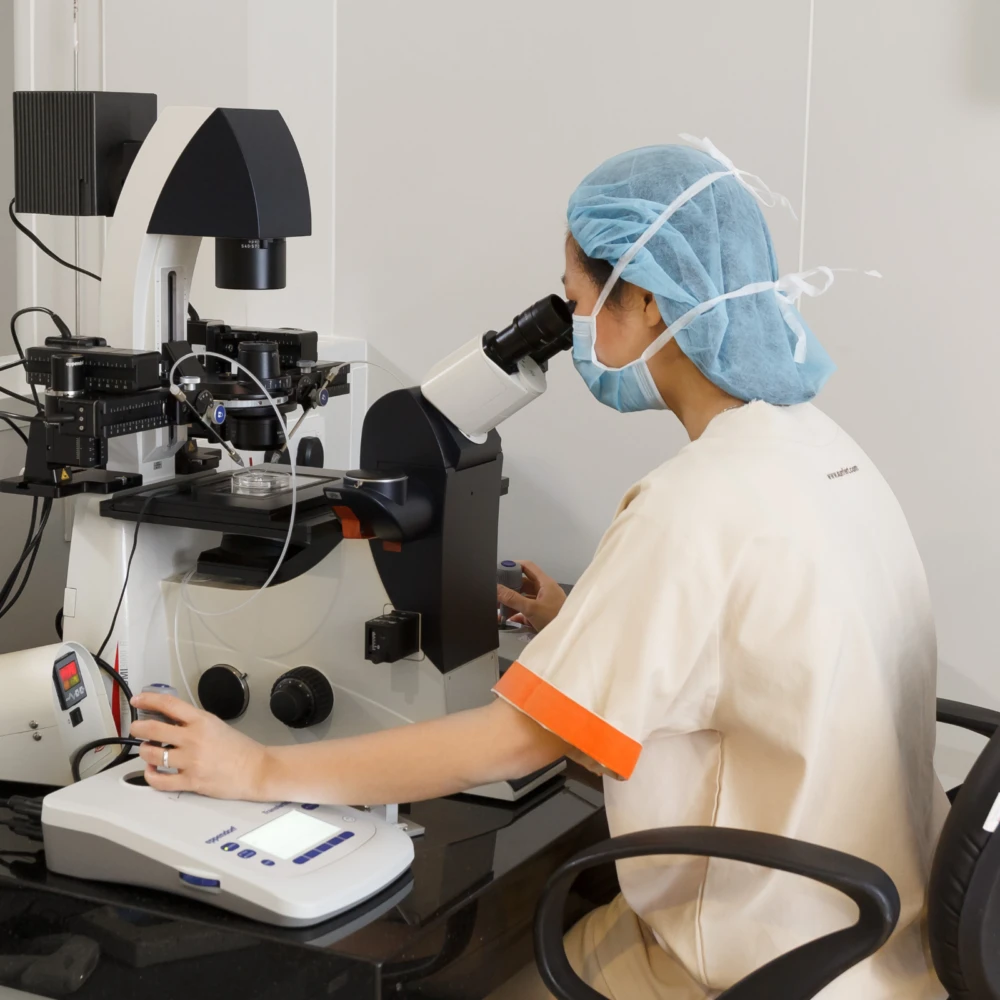
Intra-Cytoplasmic Morphologically-Selected Sperm Injection (IMSI) is an advanced laboratory technique that supports ICSI by allowing our embryologists to select sperm at a magnification of 6,000 to 7,000 times their normal size before injection into the egg.
Unlike standard ICSI, where sperm are examined under conventional microscope, IMSI uses high-powered magnification to assess sperm structure in greater detail, particularly the head, nucleus, and vacuole formation.
At Sunfert, we use IMSI when precise morphological assessment may improve treatment outcomes, especially in cases involving:
- repeated fertilisation failure
- severe sperm morphology abnormalities
- previous poor embryo development
- recurrent implantation failure
By combining advanced sperm selection techniques and ultra-high magnification microscopy, IMSI enables our trained embryologists to select sperm with greater precision using specialised laboratory equipment.
Who Can Benefit from IMSI?
Not all patients require IMSI as we recommend it in selected clinical situations where enhanced sperm selection may improve patients’ fertility treatment outcomes.
Our fertility specialists and embryology team may consider IMSI if there is:
- severe abnormal sperm morphology
- repeated IVF or ICSI failure
- poor embryo quality despite fertilisation
- recurrent implantation failure
- high levels of sperm DNA fragmentation (in selected cases)
- advanced paternal age with compromised sperm structure
By personalising our fertility treatment approach, IMSI is used strategically rather than routinely, only when it offers measurable benefit, so our patients do not incur additional costs for procedures that may not be necessary.
When Should A Patient Consider IMSI?
At Sunfert, we decide using IMSI for patient’s IVF treatment if:
- ICSI has failed previously
- embryos fertilise but do not develop optimally
- patient have experienced repeated implantation failure
- patient semen analysis shows significant morphological abnormalities
At Sunfert, our specialists conduct a comprehensive fertility assessment before determining whether IMSI is indicated.
Importantly, IMSI is often performed as part of an advanced IVF cycle where laboratory refinement is required and the recommendation is always based on medical evidence, not assumption.
How is IMSI Performed at Sunfert?
It can be done in 8 steps.
Step 1: Fertility Evaluation
During a fertility assessment, we conduct a comprehensive evaluation for both partners to identify potential factors affecting fertility and guide a personalised treatment plan.
- Both Spouses: Review of medical history, reproductive history, and previous fertility treatment outcomes.
- Female Spouse: Hormonal profile testing, ovarian reserve assessment, and evaluation of the pelvic organs (uterus, ovaries, cervix, fallopian tubes).
- Male Spouse: Semen analysis to assess sperm quality and reproductive potential and Sperm DNA Fragmentation Test to measure the percentage of sperm with damaged DNA, providing deeper insight into the sperm conditions.
This allows our team to determine whether advanced sperm morphology selection through IMSI is clinically justified.
Step 2: Ovulation Stimulation
Hormonal medications will be given by our doctors which used to stimulate the ovaries to produce multiple eggs.
This stage usually starts at Day 2 or Day 3 of the patient’s menstrual cycle and typically lasts about 10 to 12 days depending on the treatment protocol the patient undergoes.
Step 3: Oocyte Pick-Up (OPU)
Also known as egg retrieval, this is a minimally invasive procedure in which our fertility specialist collects eggs from the patient’s ovaries. The procedure typically takes about 20 to 30 minutes to complete.
During OPU, patients are given light anaesthesia or monitored sedation by an anaesthetist, ensuring that they remain comfortable and pain-free throughout the procedure.
Before concluding the procedure, our fertility specialist will carefully examine the vaginal puncture site to ensure there is no bleeding.
After OPU, patients are observed for 1 to 2 hours in our day ward before being discharged home.
Most patients experience only mild bloating, cramping, or minimal bleeding, and many are able to return to their normal routine the next day.
Step 4: Ultra-High Magnification Sperm Selection
This is where IMSI differs significantly from standard ICSI.
Our embryologists:
- examine sperm under ultra-high magnification
- assess detailed morphology
- evaluate nuclear shape and presence of vacuoles
- Select sperm with optimal structural integrity
Only sperm that meet strict morphological criteria are chosen for injection.
Step 5: Sperm Injection
Inject the selected sperm carefully into the egg cytoplasm with a specialised microinjection tool.
Step 6: Embryo Culture & Monitoring
Fertilised eggs are monitored in our laboratory for 5 to 7 days to develop into viable embryos.
Some patients may choose to undergo Pre-implantation Genetic Testing (PGT), such as PGT-A or PGT-M, to screen their embryos before transfer.
To know why some patients choose to have PGT with their IVF treatment, click the link here to learn more.
- PGT-A (Pre-implantation Genetic Testing for Aneuploidy)
- PGT-M (Pre-implantation Genetic Testing for Monogenic/Single Gene Disorders)
Step 7: Embryo Transfer
The embryo with the highest chance of success, based on quality and development, will be selected for transfer into the patient’s uterus.
Any remaining embryos will be frozen to give the patient another opportunity at attempting pregnancy in the future.
Step 8: Post-Transfer Support
Patients receive guidance and hormone support while awaiting Beta hCG pregnancy testing.
At every stage, Sunfert provides personalised care, clear instructions, and continuous support to ensure comfort and confidence.
Take the Next Step with Our Fertility Specialists
If you are facing fertility challenges, start with a consultation with our specialists. We will guide you through your fertility journey with expertise and compassionate care.
Make an appointment with our Fertility Specialist today and take the next step toward your parenthood goals.
Is intra-cytoplasmic morphologically-selected sperm injection (IMSI) available at any fertility centres in Malaysia?
Intra-cytoplasmic morphologically-selected sperm injection (IMSI) is not widely available at all fertility centres, as it requires significant investment in specialised equipment and highly trained embryologists to perform the procedure.
At Sunfert, as one of the prominent fertility service providers in Malaysia, we offer a full range of fertility services, including IMSI.
What is intra-cytoplasmic morphologically-selected sperm injection (IMSI)?
Intra-cytoplasmic morphologically-selected sperm injection (IMSI) is an advanced form of intra-cytoplasmic sperm injection (ICSI) that uses ultra-high magnification (up to 6,000 to 7,000 times) to select sperm with the best structural quality before injection into the egg.
This allows more detailed assessment of sperm head, nucleus, and vacuoles to improve selection precision.
Who can benefit from intra-cytoplasmic morphologically-selected sperm injection (IMSI)?
Intra-cytoplasmic morphologically-selected sperm injection (IMSI) may benefit patients with severe sperm morphology abnormalities, repeated IVF or ICSI failure, poor embryo development, recurrent implantation failure, or selected cases of high sperm DNA fragmentation or advanced paternal age.
When is intra-cytoplasmic morphologically-selected sperm injection (IMSI) recommended?
Intra-cytoplasmic morphologically-selected sperm injection (IMSI) is recommended when previous intra-cytoplasmic sperm injection (ICSI) cycles have failed, embryos fertilise but do not develop well, implantation repeatedly fails, or semen analysis shows significant sperm morphology issues.
How is intra-cytoplasmic morphologically-selected sperm injection (IMSI) different from ICSI?
Intra-cytoplasmic morphologically-selected sperm injection (IMSI) differs from standard intra-cytoplasmic sperm injection (ICSI) by using significantly higher magnification to evaluate sperm morphology in greater detail.
This helps our embryologists at Sunfert to select sperm with optimal structural integrity, especially in complex male infertility cases.
Is intra-cytoplasmic morphologically-selected sperm injection (IMSI) better than ICSI?
Intra-cytoplasmic morphologically-selected sperm injection (IMSI) is not universally better than intra-cytoplasmic sperm injection (ICSI).
It offers enhanced sperm selection precision and is mainly beneficial in specific male infertility cases rather than routine use.
Does intra-cytoplasmic morphologically-selected sperm injection (IMSI) improve IVF success rates?
Intra-cytoplasmic morphologically-selected sperm injection (IMSI) may improve outcomes in selected cases, particularly where sperm morphology is severely abnormal or previous IVF cycles have failed.
However, it is not required for all patients undergoing IVF.
Can intra-cytoplasmic morphologically-selected sperm injection (IMSI) be combined with genetic testing?
Intra-cytoplasmic morphologically-selected sperm injection (IMSI) can be combined with Pre-implantation Genetic Testing (PGT-A or PGT-M) to help screen embryos for chromosomal or genetic disorder before transfer.
Why is fertility assessment important before intra-cytoplasmic morphologically-selected sperm injection (IMSI)?
Intra-cytoplasmic morphologically-selected sperm injection (IMSI) involves a detailed fertility assessment to determine whether advanced sperm selection is clinically appropriate.
This ensures treatment is evidence-based and tailored to each couple’s needs.
At Sunfert, transparency is a core value. We only recommend additional procedures when there is clear clinical evidence that they may benefit our patients.
Is intra-cytoplasmic morphologically-selected sperm injection (IMSI) painful?
Intra-cytoplasmic morphologically-selected sperm injection (IMSI) itself is not painful for patients.
The procedure is performed in the laboratory.
Egg retrieval and embryo transfer are done under appropriate medical care, with minimal discomfort managed by sedation or clinical support.
Is intra-cytoplasmic morphologically-selected sperm injection (IMSI) safe?
Intra-cytoplasmic morphologically-selected sperm injection (IMSI) is considered safe and follows the same clinical and laboratory safety standards as intra-cytoplasmic sperm injection (ICSI), with additional precision in sperm selection under high magnification.
-
 Book a consultation
Dato' Dr Wong Pak Seng
Founder of Sunfert Group & Fertility Specialist- Sunfert@Bangsar South
-
 Book a consultation
Dr Eeson Sinthamoney
Group Medical Director & Fertility Specialist- Sunfert@Bangsar South
-
 Book a consultation
Dr Lim Lei Jun
Medical Director (Sunfert Bangsar South) & Fertility Specialist- Sunfert@Bangsar South
-
 Book a consultation
Dr Sumithra Devi Valiapan
Consultant Obstetrician, Gynaecologist & Fertility Specialist- Sunfert@Bangsar South
-
 Book a consultation
Dr Haris Njoo Suharjono
Medical Director (Sunfert Kuching) & Fertility Specialist- Sunfert@Kuching
-
 Book a consultation
Dr Evelyn Pang Mei Foong
Obstetrics, Gynaecology & Fertility Specialist- Sunfert@Seremban
-
 Book a consultation
Dr Chong Jie Wen
Consultant Obstetrician, Gynaecologist & Fertility Specialist (Sessional)- Sunfert@Ipoh
-
 Book a consultation
Dr Rohani Binti Effendy
Consultant Obstetrician, Gynaecologist & Fertility Specialist (Sessional)- Sunfert@Bangsar South