

What is Laser-Assisted Hatching?
Laser-Assisted Hatching (LAH) is an advanced laboratory technique used during In-Vitro Fertilisation (IVF) to help an embryo break through its outer protective layer before implantation.
Each embryo is surrounded by a thin outer shell called the zona pellucida. Before an embryo can implant into the uterus, it must naturally “hatch” from this shell.
In some cases, the zona pellucida may be thicker or harder, making it more difficult for the embryo to hatch.
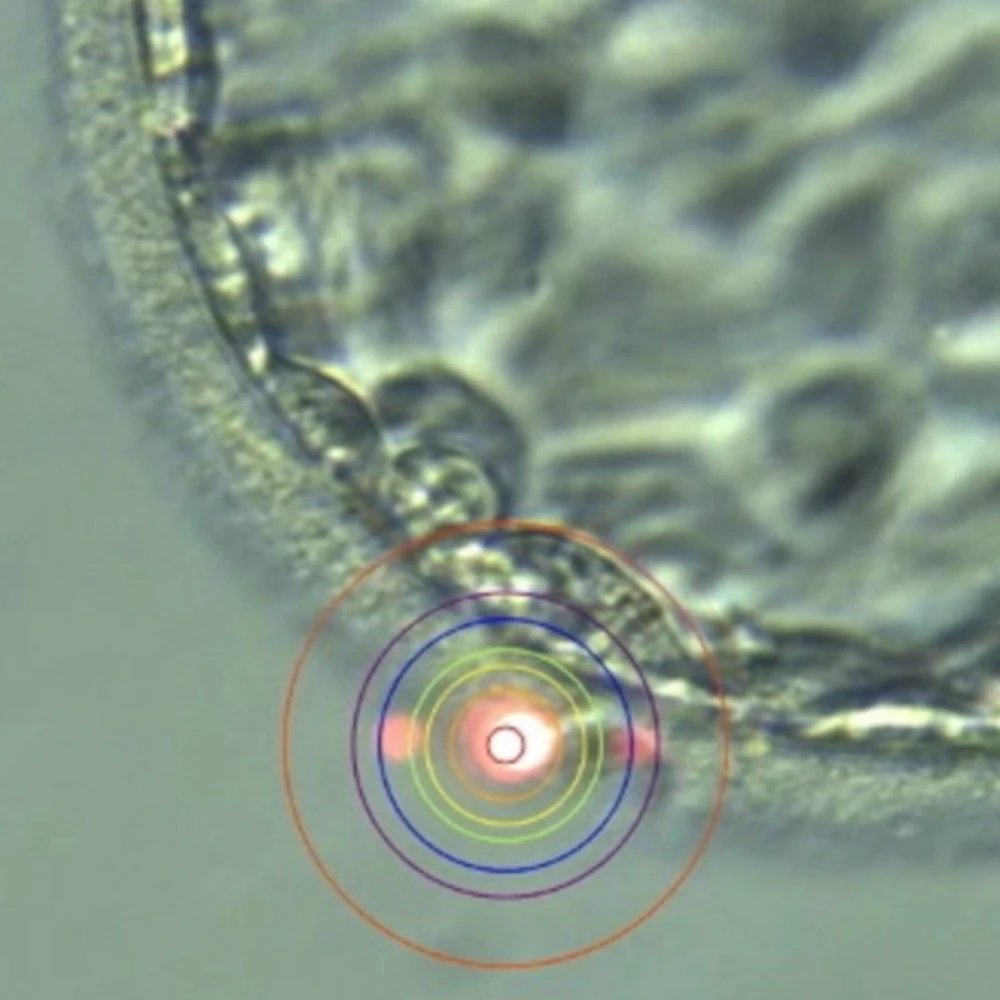
At Sunfert, we may perform Laser-Assisted Hatching by using a highly precise medical laser to create a tiny opening in the zona pellucida. This can assist the embryo in hatching and improve the chances of implantation in selected patients.
Our embryology team carefully evaluates each embryo to determine whether Laser-Assisted Hatching is necessary before proceeding with the procedure.
Who Can Benefit from Laser-Assisted Hatching?
Laser-Assisted Hatching may benefit certain patients undergoing IVF who have factors that could affect the embryo’s ability to hatch and implant.
At Sunfert, we may consider Laser-Assisted Hatching for patients who have:
- previous failed IVF cycles
- advanced maternal age
- embryos with a thicker zona pellucida
- limited number of embryos available for transfer
- frozen embryo transfer cycles
In these situations, Laser-Assisted Hatching may help the embryo hatch from its outer shell more easily, which may improve its ability to attach to the uterine lining.
However, it is important to note that Laser-Assisted Hatching is not necessary for all IVF patients. Our embryology team will recommend it only when there is clinical evidence that it may improve the likelihood of implantation.
How is Laser-Assisted Hatching Performed at Sunfert?
Step 1: Embryo Development
After fertilisation, embryos are cultured in the laboratory for several days while their development is carefully monitored.
Step 2: Embryo Assessment
Our embryologists evaluate the embryo quality and the thickness of the zona pellucida.
Step 3: Performing Laser-Assisted Hatching
A highly precise laser beam will be used to create a small opening in the outer shell of the embryo.
Laser-Assisted Hatching is performed shortly before the embryo transfer procedure. It can be applied to embryos at the early cleavage stage (typically 2 to 3 days after egg retrieval) or at the blastocyst stage (usually 5 to 6 days after egg retrieval).
Step 4: Embryo Transfer
The embryo is then ready for transfer into the uterus.
Take the Next Step with Our Fertility Specialists
If you are facing fertility challenges, start with a consultation at Sunfert. We will guide you through your fertility journey with expertise and compassionate care.
Make an appointment with our Fertility Specialist today and take the next step toward your parenthood goals.
-
 Book a consultation
Dato' Dr Wong Pak Seng
Founder of Sunfert Group & Fertility Specialist- Sunfert@Bangsar South
-
 Book a consultation
Dr Eeson Sinthamoney
Group Medical Director & Fertility Specialist- Sunfert@Bangsar South
-
 Book a consultation
Dr Lim Lei Jun
Medical Director (Sunfert Bangsar South) & Fertility Specialist- Sunfert@Bangsar South
-
 Book a consultation
Dr Sumithra Devi Valiapan
Consultant Obstetrician, Gynaecologist & Fertility Specialist- Sunfert@Bangsar South
-
 Book a consultation
Dr Haris Njoo Suharjono
Medical Director (Sunfert Kuching) & Fertility Specialist- Sunfert@Kuching
-
 Book a consultation
Dr Tham Seong Wai
Medical Director (Sunfert Ipoh) & Fertility Specialist- Sunfert@Ipoh
-
 Book a consultation
Dr Evelyn Pang Mei Foong
Obstetrics, Gynaecology & Fertility Specialist- Sunfert@Seremban
-
 Book a consultation
Dr Chong Jie Wen
Consultant Obstetrician, Gynaecologist & Fertility Specialist (Sessional)- Sunfert@Ipoh
-
 Book a consultation
Dr Rohani Binti Effendy
Consultant Obstetrician, Gynaecologist & Fertility Specialist (Sessional)- Sunfert@Bangsar South
What is Laser-Assisted Hatching in IVF?
Laser-Assisted Hatching (LAH) is an advanced IVF laboratory technique that helps an embryo break through its outer shell, known as the zona pellucida, before implantation.
A precise medical laser is used to create a small opening, which may support the embryo in successfully attaching to the uterine lining.
Does Laser-Assisted Hatching improve IVF success rates?
Laser-Assisted Hatching may improve implantation rates in specific groups of patients, particularly those with repeated IVF failure or poor embryo hatching potential. However, results vary, and it is not universally beneficial for all patients undergoing IVF.
Does Laser-Assisted Hatching guarantee pregnancy?
No. While Laser-Assisted Hatching may support implantation in selected cases, no IVF technique can guarantee pregnancy. Success depends on multiple factors, including embryo quality, uterine health, and patient age.
Is Laser-Assisted Hatching safe for embryos?
Yes, Laser-Assisted Hatching is considered a safe and well-established assisted reproductive technology.
At Sunfert, it is performed by well-trained embryologists using advanced IVF laboratory technology, ensuring high precision while minimising risk to the embryo.
Is Laser-Assisted Hatching included in IVF treatment costs?
At Sunfert, Laser-Assisted Hatching is included as part of IVF treatment when clinically indicated. Patients are not charged any additional fees for this service.
Is Laser-Assisted Hatching performed before embryo transfer?
Yes. The procedure is done in our IVF laboratory shortly before the embryo transfer to ensure the embryo is ready for implantation.
Is Laser-Assisted Hatching used in frozen embryo transfer (FET)?
Yes, it is commonly considered in frozen embryo transfer cycles, as freezing and thawing may affect the zona pellucida, making hatching more difficult for some embryos.
Is Laser-Assisted Hatching necessary for every IVF cycle?
No. Laser-Assisted Hatching is not required for all IVF patients.
It is only recommended when there is clinical evidence suggesting that the embryo may have difficulty hatching on its own.