

How To Check The Ovarian Reserve?
At Sunfert, we believe understanding ovarian reserve is a key step for a woman in planning her fertility journey.
The Anti-Mullerian Hormone (AMH) test is the most reliable assessment to assess ovarian reserve and is often the first test encouraged by many experienced fertility specialists.
- It is a single blood test and can be done anytime during the menstrual cycle.
- It estimates how the ovaries may respond to stimulation during an IVF cycle.
- It may help identify women at risk of early menopause and earlier fertility decline.
What is AMH?
AMH is produced by granulosa cells of early developing ovarian follicles. It is closely linked to your age and antral follicle count (AFC) in your ovaries, helping show how many eggs you might have left. While high AMH may indicate a higher egg quantity, it does not guarantee pregnancy. Likewise, low AMH does not necessarily mean infertility.
Notes:
- Granulosa Cells: Helper cells in the ovary that surround and nurture a developing egg, providing nutrients and signals for its growth. They also produce estrogen and assist in ovulation, making them essential for fertility.
- Antral Follicle Count (AFC): Is the number of small, early-stage eggs visible in the ovaries on an ultrasound.
AMH testing is especially important today as more women in Malaysia are delaying childbearing into their 30s and 40s.
Tracking AMH levels helps women to:
- understand their reproductive health
- plan their parenthood timeline
- consider options like egg freezing, if needed
Interpreting AMH Levels
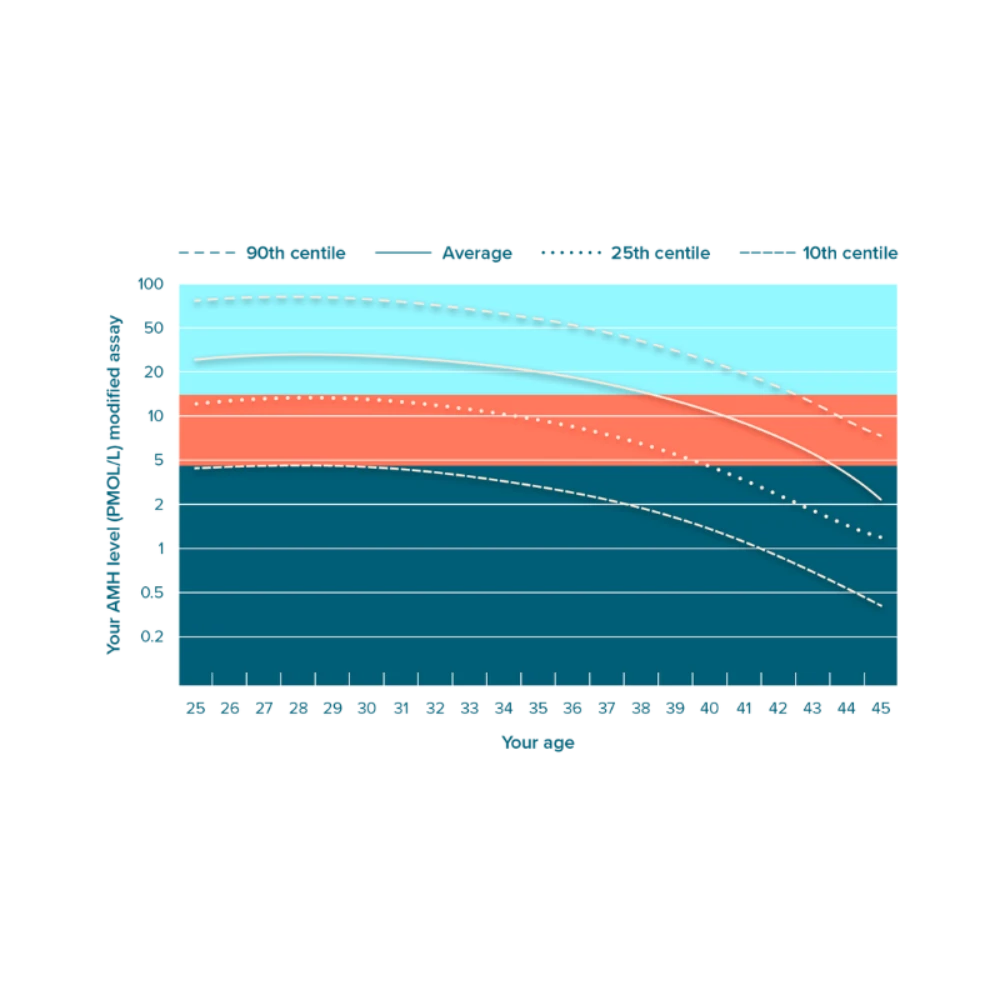
Normal AMH Levels
In recent years, several charts have been developed showing normal AMH levels from birth to menopause:
- Before puberty: AMH is low
- Early puberty: AMH rises
- Ages 20 to 25: AMH peaks
- After 25: AMH gradually declines and is usually undetectable by menopause
The reason AMH rises during early puberty is still unknown.
Practical tip: AMH is most useful for assessing ovarian ageing in women over 25.
High AMH Levels
When AMH exceeds 48 pmol/L, it may indicate Polycystic Ovarian Syndrome (PCOS).
- PCOS is the most common hormonal disorder in women of reproductive age and a frequent cause of subfertility.
- Hormonal imbalances in PCOS prevent the regular development of a dominant follicle, leading to irregular or infrequent ovulation.
- As a result, many immature eggs remain in the ovaries.
These eggs, within their follicles, produce AMH, which explains why women with PCOS often have elevated AMH levels.
Low AMH Levels
Low AMH indicates lower number of eggs (follicles), often termed low ovarian reserve.
It is important to read AMH in the context of many factors, most importantly your age.
Women are said to have diminished ovarian reserve (DOR), when the number of eggs is much lower than expected for women the same age.
When this happens, your doctor might get you to perform some genetic screening such as Fragile X Syndrome.
Other causes of DOR are:
- Smoking
- Endometriosis
- Ovarian Surgery
- Cancer Treatment
- Autoimmune Diseases
- Pelvic Inflammatory Disease (PID)
In many cases, no apparent cause can be identified.
If a woman experiences menopause before the age of 40, they have Premature Ovarian Insufficiency (POI), which impacts 1 in 100 women.
Women with POI can experience symptoms such as irregular periods, typically shortening of menstrual cycles well into their 30s.
-
 Book a consultation
Dato' Dr Wong Pak Seng
Founder of Sunfert Group & Fertility Specialist- Sunfert@Bangsar South
-
 Book a consultation
Dr Eeson Sinthamoney
Group Medical Director & Fertility Specialist- Sunfert@Bangsar South
-
 Book a consultation
Dr Lim Lei Jun
Medical Director (Sunfert Bangsar South) & Fertility Specialist- Sunfert@Bangsar South
-
 Book a consultation
Dr Sumithra Devi Valiapan
Consultant Obstetrician, Gynaecologist & Fertility Specialist- Sunfert@Bangsar South
-
 Book a consultation
Dr Haris Njoo Suharjono
Medical Director (Sunfert Kuching) & Fertility Specialist- Sunfert@Kuching
-
 Book a consultation
Dr Tham Seong Wai
Medical Director (Sunfert Ipoh) & Fertility Specialist- Sunfert@Ipoh
-
 Book a consultation
Dr Evelyn Pang Mei Foong
Obstetrics, Gynaecology & Fertility Specialist- Sunfert@Seremban
-
 Book a consultation
Dr Chong Jie Wen
Consultant Obstetrician, Gynaecologist & Fertility Specialist (Sessional)- Sunfert@Ipoh
-
 Book a consultation
Dr Rohani Binti Effendy
Consultant Obstetrician, Gynaecologist & Fertility Specialist (Sessional)- Sunfert@Bangsar South
What is an AMH test and what does it measure?
The Anti-Müllerian Hormone (AMH) test is a blood test used to measure AMH levels, a hormone associated with ovarian reserve.
It helps indicate potential egg reserve and supports informed fertility planning and treatment decisions.
When should I consider an AMH test?
An Anti-Müllerian Hormone (AMH) test is recommended if you are:
- aged 25 and above
- planning pregnancy in the future
- experiencing difficulty conceiving
- considering IVF or fertility preservation
It can be taken at any time during the menstrual cycle for convenience.
Why is the AMH test important for fertility?
The Anti-Müllerian Hormone (AMH) test helps assess how the ovaries may respond to fertility treatments such as IVF.
It offers valuable insight into fertility potential, allowing doctors to tailor treatment plans and improve the chances of success.
Why is AMH important for women in Malaysia today?
As more women in Malaysia choose to delay childbirth into their 30s and 40s, AMH testing has become increasingly important.
It helps women understand their reproductive timeline and consider options such as fertility planning or egg freezing where appropriate.
How does AMH help with IVF planning?
Anti-Müllerian Hormone (AMH) helps fertility specialists estimate how the ovaries may respond to stimulation during IVF.
This allows for more personalised treatment planning, helping optimise medication dosage and improve overall treatment strategy.
Does Sunfert use AMH testing in fertility assessment?
Yes, Anti-Müllerian Hormone (AMH) testing is commonly used as part of fertility assessment to evaluate ovarian reserve and support personalised treatment planning.
It is often combined with other diagnostic tools to provide a more complete understanding of reproductive health.
What does a low AMH level mean?
Low Anti-Müllerian Hormone (AMH) suggests a reduced number of eggs, also known as diminished ovarian reserve (DOR).
It may indicate a lower response to fertility treatment, but it does not mean pregnancy is impossible, especially when assessed together with age and other fertility factors.
What causes low AMH levels?
Low Anti-Müllerian Hormone (AMH) may be associated with:
- advancing age
- smoking
- endometriosis
- ovarian surgery
- cancer treatment
- autoimmune conditions
- pelvic inflammatory disease (PID)
In some cases, no clear cause is identified.
Can you still get pregnant with low AMH?
Yes, pregnancy is still possible with low Anti-Müllerian Hormone (AMH).
Fertility outcomes depend on multiple factors, particularly age and egg quality. Many women with low AMH successfully conceive naturally or with assisted reproductive treatments such as IVF.
What does a high AMH level mean?
A high Anti-Müllerian Hormone (AMH) level (often above 48 pmol/L) may be associated with Polycystic Ovarian Syndrome (PCOS).
This condition involves hormonal imbalance that disrupts regular ovulation, leading to multiple immature follicles in the ovaries, which produce higher AMH levels.
Does high AMH mean better fertility?
Not necessarily. High Anti-Müllerian Hormone (AMH) indicates a higher number of follicles but does not guarantee better fertility.
In some cases, such as PCOS, ovulation may be irregular, which can actually make natural conception more challenging without medical support.
What is considered a normal AMH level?
Anti-Müllerian Hormone (AMH) levels vary with age. Generally:
- Before puberty: Low AMH
- Early puberty: AMH rises
- Ages 20–25: Peak levels
- After 25: Gradual decline
AMH is most useful clinically for women aged 25 and above to assess ovarian ageing.