

What is Time-Lapse Embryo Imaging?
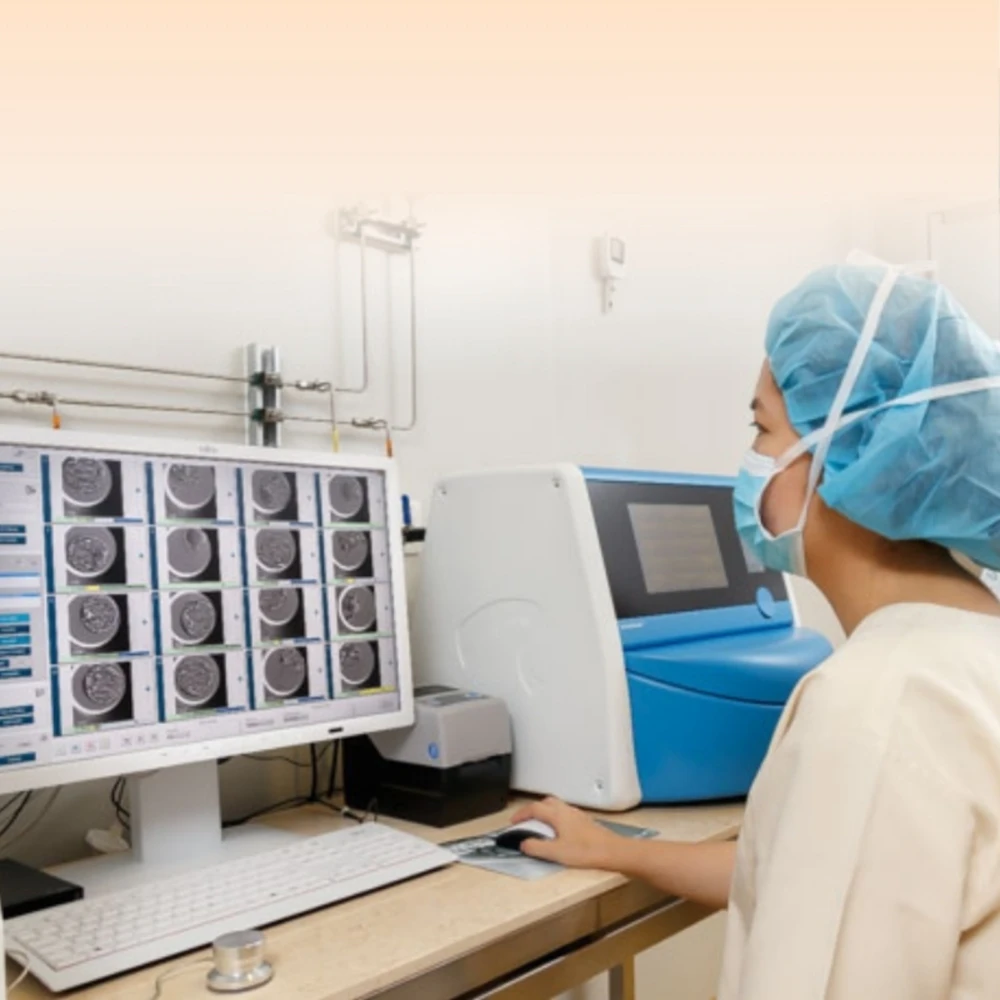
Time-Lapse Embryo Imaging is an advanced embryo monitoring technology that allows us to observe embryo development continuously without removing them from the incubator.
Instead of checking embryos at fixed time points under a traditional microscope, we capture high-resolution images at regular intervals to track every developmental milestone.
At Sunfert, we use this technology to gain deeper insights into embryo growth patterns, cell division timing, and morphology changes.
This gives us more comprehensive data when selecting the best embryos for transfer in order to increase the success rate of our patients’ IVF treatments.

How It Compares With Traditional Embryo Monitoring?
Traditional embryo assessment:
- requires embryos to be removed from the incubator for observation
- provides static snapshots at specific time points
- may be affected due to environmental fluctuation during handling
Time-lapse embryo imaging:
- monitors embryos continuously inside a stable incubator environment
- captures dynamic development data
- reduces disturbance and improves observational accuracy
In our experience, continuous monitoring enhances precision in embryo selection and supports better-informed clinical decisions.
EmbryoScope Plus (ES+)
At Sunfert, we utilise one of the most advanced time-lapse embryo imaging systems available in the industry, which is known as the EmbryoScope Plus (also known as “EmbryoScope+” or “ES+”).
The EmbryoScope Plus is an integrated time-lapse incubator equipped with built-in imaging technology. It allows embryos to develop in a stable environment while being photographed automatically at frequent intervals.
What Makes EmbryoScope Plus Special?
We value systems that combine technology with clinical reliability.
At Sunfert, we choose EmbryoScope Plus because it can:
1. Apply Artificial Intelligence (AI) in Embryo Evaluation
The EmbryoScope Plus supports time-lapse-based embryo analysis through iDAScore, KIDScore decision support tools and guided annotation.
iDAScore:
- iDAScore is an AI-based scoring system trained on over 180,000 time-lapse embryo sequences with known clinical outcomes, allowing it to recognise developmental patterns associated with healthy embryos at different stages.
- This empowers it to evaluate embryos not only by their final appearance but also by their continuous developmental progression, giving our embryologists a more comprehensive and objective view of each embryo’s key milestone achievements throughout development.
KIDScore Decision Support Tools:
- It is a set of tools that are designed to support our embryologists in their decision about which embryos to transfer, freeze or avoid.
Guided Annotation:
- Guided Annotation is an AI-powered tool that supports the IVF embryo assessment process by streamlining data collection and ensuring accurate documentation of embryo development. It works together with KIDScore decision support tools to objectively rank embryos based on their likelihood of implantation, helping our embryologists make more informed and data-driven transfer decisions.
2. Accommodate More Embryos in Each Incubator
EmbryoScope Plus is able to accommodate more embryos compared to many traditional IVF incubators, as well as the previous version of EmbryoScope™.
This enables us at Sunfert to monitor a higher number of embryos simultaneously, making advanced time-lapse technology accessible to more patients.
As one of the leading fertility service providers in Malaysia, we aim to enhance the accessibility of high-end time-lapse embryo imaging technology for our patients and establish it as a new benchmark and standard within the IVF industry.
3. Monitor Embryo Development 24/7 With Minimal Disturbance
Compared with conventional incubators, the EmbryoScope Plus provides both incubation stability and advanced imaging within one system. This integration improves workflow efficiency while preserving embryo safety.
Who Can Benefit From the Use of EmbryoScope™?
Time-lapse embryo imaging is beneficial for many patients undergoing IVF treatment.
It is particularly useful for individuals or couples who:
- have experienced previous failed IVF cycles
- require better embryo selection precision
- are undergoing pre-implantation genetic testing (PGT)
- wish to maximise embryo selection confidence
- produce multiple embryos and need refined ranking tools
At Sunfert, we apply this technology across suitable cases to improve our overall embryo assessment strategy.
Sunfert Embryologist Team and EmbryoScope Plus
At Sunfert, we believe technology alone is not enough, it is the people behind it that truly make the difference. While AI and advanced embryo assessment tools enhance accuracy, our highly trained embryologists combine expertise, experience, and compassion with innovation to deliver the best possible care.
By investing in both people and technology, we continue to raise the standard of fertility care for our patients.
We integrate advanced systems such as EmbryoScope Plus with the expertise of our embryology team to ensure meaningful clinical interpretation and support more informed decision-making.
Through this integrated approach, our embryologists:
- Continuously monitor embryo development data generated by the system
- Analyse morphokinetic patterns alongside each patient’s clinical context
- Apply professional expertise and judgement in embryo grading and selection
We believe such an approach is an essential part of the personalised care that we promised to all our patients, and the synergy between advanced technology and our skilled embryologists will enable us to deliver more reliable outcomes and greater confidence for our patients.
How Much Do We Charge for Time-Lapse Embryo Imaging?
At Sunfert, time-lapse embryo imaging is included in most of our fertility treatment packages at no additional cost.
We integrate it into our IVF laboratory process to ensure it is accessible to all our patients.
If you would like a video of your embryo(s), simply contact us, and we will prepare it for you at no additional cost.
Take the Next Step with Our Fertility Specialists
If you are facing fertility challenges, start with a consultation at Sunfert. We will guide you through your fertility journey with expertise and compassionate care.
Make an appointment with our Fertility Specialist today and take the next step toward your parenthood goals.
-
 Book a consultation
Dato' Dr Wong Pak Seng
Founder of Sunfert Group & Fertility Specialist- Sunfert@Bangsar South
-
 Book a consultation
Dr Eeson Sinthamoney
Group Medical Director & Fertility Specialist- Sunfert@Bangsar South
-
 Book a consultation
Dr Lim Lei Jun
Medical Director (Sunfert Bangsar South) & Fertility Specialist- Sunfert@Bangsar South
-
 Book a consultation
Dr Sumithra Devi Valiapan
Consultant Obstetrician, Gynaecologist & Fertility Specialist- Sunfert@Bangsar South
-
 Book a consultation
Dr Haris Njoo Suharjono
Medical Director (Sunfert Kuching) & Fertility Specialist- Sunfert@Kuching
-
 Book a consultation
Dr Tham Seong Wai
Medical Director (Sunfert Ipoh) & Fertility Specialist- Sunfert@Ipoh
-
 Book a consultation
Dr Evelyn Pang Mei Foong
Obstetrics, Gynaecology & Fertility Specialist- Sunfert@Seremban
-
 Book a consultation
Dr Chong Jie Wen
Consultant Obstetrician, Gynaecologist & Fertility Specialist (Sessional)- Sunfert@Ipoh
-
 Book a consultation
Dr Rohani Binti Effendy
Consultant Obstetrician, Gynaecologist & Fertility Specialist (Sessional)- Sunfert@Bangsar South
What is Time-Lapse Embryo Imaging in IVF?
Time-Lapse Embryo Imaging is an advanced IVF technology that continuously monitors embryo development inside a stable incubator without removing embryos for observation.
It captures high-resolution images at regular intervals to track key developmental stages such as cell division and embryo growth, helping embryologists assess embryo quality more precisely.
Is Time-Lapse Embryo Imaging available at any fertility centre?
No. Time-Lapse Embryo Imaging is an advanced assisted reproductive technology that requires significant investment and is therefore not widely available across all fertility centres.
Meanwhile, EmbryoScope Plus is one of the most advanced time-lapse embryo imaging systems in the fertility industry, offering high-precision monitoring and enhanced embryo assessment capabilities.
What is the difference between traditional embryo monitoring and time-lapse imaging?
Traditional embryo monitoring involves removing embryos from the incubator for periodic checks, which provides limited snapshots.
Time-lapse imaging keeps embryos inside a controlled incubator and records continuous development, reducing disturbance and improving accuracy in embryo assessment.
Is Time-Lapse Embryo Imaging safe for embryos?
Yes. Time-lapse imaging is safe because embryos remain inside a stable incubator throughout the entire process.
This minimises handling, maintains optimal culture conditions, and supports normal embryo development.
How does Time-Lapse Embryo Imaging improve embryo selection?
Time-lapse imaging improves embryo selection by providing continuous developmental data instead of static snapshots.
It allows embryologists to evaluate timing of cell division, growth patterns, and morphology changes, helping identify embryos with better developmental potential for transfer or freezing.
Who can benefit from Time-Lapse Embryo Imaging?
Time-Lapse Embryo Imaging benefits IVF patients who have experienced previous failed cycles, produce multiple embryos requiring selection, or undergo pre-implantation genetic testing (PGT).
It is also useful for improving embryo selection accuracy in complex fertility cases.
Does Time-Lapse Embryo Imaging improve IVF success rates?
Time-lapse imaging does not guarantee pregnancy, but it improves embryo selection accuracy by providing detailed developmental information.
This helps embryologists make better-informed decisions, which may improve clinical outcomes in suitable cases.
Is there an extra charge for EmbryoScope Plus at Sunfert?
No. It is included as part of our standard embryo culture process.
How long are embryos monitored using time-lapse technology?
Embryos are continuously monitored from fertilisation until the blastocyst stage, typically around 5 to 7 days, depending on individual embryo development.