
The answer is Maldives.
This unique public health policy highlights how seriously the country is tackling Thalassemia and protecting future generations.
Meanwhile in Malaysia, there have also been ongoing discussions on whether Thalassemia screening should be made compulsory before marriage registration, as it is one of the most common inherited genetic disorders in the country, particularly among the Malay, Kadazan-Dusun and Chinese communities.
What Is Thalassemia?
Thalassemia is a genetic blood disorder that affects the body’s ability to produce healthy haemoglobin.
Haemoglobin plays a vital role in carrying oxygen throughout the body. When it is not produced effectively, it can result in:
- chronic anaemia
- persistent fatigue and weakness
- delayed growth in children
- serious complications in severe cases
The severity of Thalassemia can vary from mild to life threatening, depending on the type and genetic inheritance.
Why Does Maldives Require Thalassemia Screening?
In Maldives, couples must undergo Thalassemia screening as part of the legal marriage process. This policy was introduced due to the high prevalence of Thalassemia carriers within the population, creating a significant national health concern.
According to data shared during the World Health Organization Regional Director’s speech at the launch of the Thalassemia Prevention and Control Plan for Maldives on 15 October 2024, Maldivian Blood Services reported that around 16% of the population are affected by Thalassemia.
This places Maldives among the countries with the highest carrier rates globally.
By making Thalassemia screening mandatory, the country aims to:
- reduce the number of babies born with severe Thalassemia
- increase awareness among couples before marriage
- encourage informed and responsible family planning
This approach has proven to be a proactive step in reducing long term healthcare burden.
How Common is Thalassemia in Malaysia?
Although the prevalence of Thalassemia in Malaysia is not as high as in Maldives, it remains one of the most common inherited genetic disorders in the country. It is estimated that around 4.5% to 6.8% of Malaysians are Thalassemia carriers.
It is more commonly seen among the Malay, Kadazan-Dusun, and Chinese communities. Because Thalassemia can be passed down genetically from parents to children, many carriers may not realise they carry the gene until they:
- undergo Thalassemia screening
- experience repeated miscarriages related to genetic abnormalities
- have a child affected by Thalassemia
How Is Thalassemia Passed Down?
Thalassemia is inherited from parents through genes, meaning it is passed from one generation to the next.
Here is a simple breakdown:
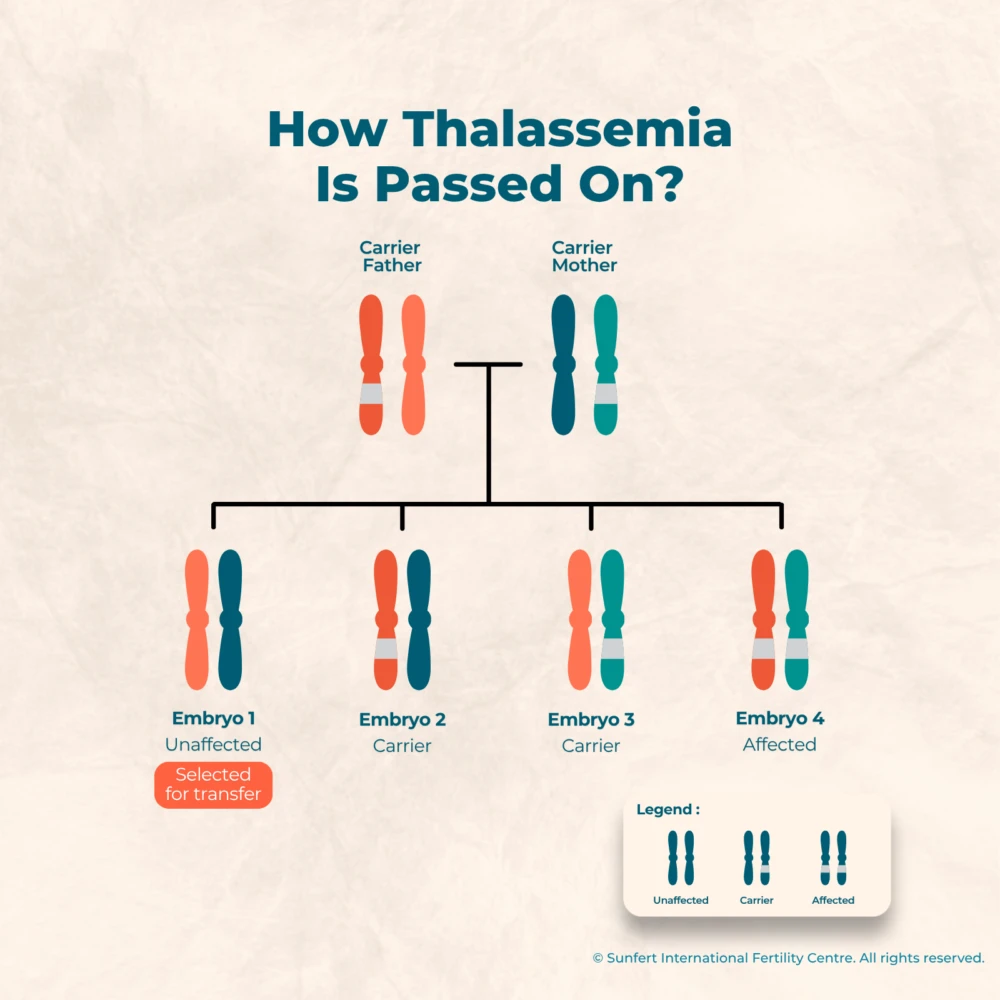
If one parent is a carrier, the child may also become a carrier but usually will not have severe symptoms
If both parents are carriers, there is:
- 25% chance the child is affected
- 50% chance the child is a carrier
- 25% chance the child is completely unaffected
This is why screening before marriage or pregnancy is highly recommended, especially in regions with higher carrier rates.
Types of Thalassemia
Thalassemia is generally classified into 2 main types:
1. Alpha Thalassemia
- Caused by inactivation or missing alpha globin chains
- Severity ranges from mild to severe
- The most severe form is often fatal
2. Beta Thalassemia
- Caused by mutations in the beta globin gene
- Beta Thalassemia Minor: Usually a carrier state with little to no symptoms
- Beta Thalassemia Major: A severe condition that often requires lifelong blood transfusions
Can Thalassemia Carriers Marry?
Yes, Thalassemia carriers can marry.
Being a carrier does not prevent someone from building a relationship or having the fruit of their love. However, understanding the genetic risks is essential.
If both partners are carriers, there is a 25% chance of having a child with Thalassemia Major in every pregnancy.
Because of this, premarital screening and genetic counselling are strongly encouraged to help couples make informed decisions.
Does That Mean Thalassemia Carrier Don’t Deserve To Have A Healthy Baby?
In the past, this situation posed significant challenges.
Today, medical advancements have changed that completely.
Couples who are both Thalassemia carriers can still have a healthy baby through IVF combined with PGT-M. This means having a safe and hopeful path towards their own baby is now possible.
What Is PGT M and How Can It Help?
Pre-implantation Genetic Testing for Monogenic Disorders, known as PGT-M, is an advanced technique used alongside IVF to help prevent genetic conditions like Thalassemia.
How PGT M works?
- Eggs and sperm are used to create embryos in a laboratory
- Each embryo is carefully tested for Thalassemia
- Only embryos without the condition are selected for transfer
Click here to learn more on how PGT-M works in Sunfert.
Benefits of PGT M:
- Reduces the risk of having a child affected by Thalassemia
- Supports safer and more informed pregnancy planning
- Provides reassurance for couples with genetic concerns
This approach has helped many couples move forward with greater confidence and peace of mind.
Take the Next Step with Our Fertility Specialists
If you are facing fertility challenges, start with a consultation with our specialists. We will guide you through your fertility journey with expertise and compassionate care.
Make an appointment with our Fertility Specialist today and take the next step toward your parenthood goals.
-
 Book a consultation
Dato' Dr Wong Pak Seng
Founder of Sunfert Group & Fertility Specialist- Sunfert@Bangsar South
-
 Book a consultation
Dr Eeson Sinthamoney
Group Medical Director & Fertility Specialist- Sunfert@Bangsar South
-
 Book a consultation
Dr Lim Lei Jun
Medical Director (Sunfert Bangsar South) & Fertility Specialist- Sunfert@Bangsar South
-
 Book a consultation
Dr Sumithra Devi Valiapan
Consultant Obstetrician, Gynaecologist & Fertility Specialist- Sunfert@Bangsar South
-
 Book a consultation
Dr Haris Njoo Suharjono
Medical Director (Sunfert Kuching) & Fertility Specialist- Sunfert@Kuching
Can 2 Thalassemia carriers have a healthy baby naturally?
Yes, but there is a risk that the baby may inherit Thalassemia Major. Genetic counselling and early testing such as PGT-M are strongly recommended.
Is IVF recommended for couples with Thalassemia?
PGT-M helps Thalassemia carrier couples reduce the risk of passing an inherited genetic disorder to their baby. To perform PGT-M, IVF treatment is required.
Is PGT-M necessary for all IVF patients?
No. PGT-M is not required for every IVF patient. It is mainly advised for couples with a known risk of passing on specific genetic disorders. Our fertility specialist will recommend PGT-M based on medical history, genetic screening results, and individual circumstances.
If you are unsure whether you or your partner are carriers of certain genetic conditions, you may consider undergoing an Expanded Carrier Screening (ECS) blood test for further assessment.
Who should consider PGT-M?
PGT-M is recommended for individuals or couples with known genetic risks, including:
- carriers of inherited genetic disorders
- individuals affected by genetic conditions
- family history of inherited diseases
- previous child or pregnancy affected by genetic disorders
- couples planning IVF who want to reduce hereditary risk
When should I speak to a fertility specialist about PGT-M?
You should consult a fertility specialist if you:
- know you or your partner carries a genetic condition
- have a family history of inherited disorders
- have experienced previous genetic-related pregnancy loss
- wish to explore safer IVF options
At Sunfert, our fertility specialists can help determine whether PGT-M is suitable for your situation. Transparency and honesty are core to our values.
We ensure that any additional procedures are recommended only when there is clear clinical benefit, so patients do not undergo or incur costs for treatments that are not necessary for their fertility journey.
Can PGT-M prevent genetic diseases completely?
PGT-M significantly reduces the risk of passing specific inherited genetic disorders by selecting unaffected embryos.
However, it does not guarantee a completely disease-free baby, as it targets only specific known gene mutations.
Does PGT-M improve IVF success rates?
PGT-M does not directly increase implantation rates, but it improves the likelihood of transferring embryos that are free from specific genetic disorders.
This contributes to better pregnancy outcomes and reduces the risk of inherited disease.
Can PGT-M help reduce miscarriage risk?
Yes, in some cases. By selecting embryos that are free from specific genetic disorders, PGT-M may lower the risk of miscarriage associated with inherited conditions, supporting a healthier pregnancy outcome.
How long does the PGT-M process take?
The timeline varies depending on the complexity of the genetic condition. Typically:
- Genetic preparation and probe development may take several weeks
- IVF cycle and embryo testing follow afterwards
Your fertility specialist will provide a personalised timeline based on your case.
What is Sunfert IVF with PGT-M Package?
IVF with PGT-M is a fertility treatment that combines In-vitro Fertilisation (IVF) with Pre-Implantation Genetic Testing for Monogenic Disorders (PGT-M).
It allows embryos to be tested for specific inherited genetic conditions before transfer.
This helps select embryos free from targeted disorders, supporting healthier pregnancy outcomes and reducing the risk of passing on genetic diseases.
Who should consider Sunfert IVF with PGT-M Package?
IVF with PGT-M is recommended for couples who:
- are carriers of known genetic disorders
- have a family history of inherited diseases
- have previously had a child affected by a genetic condition
- wish to reduce the risk of passing on monogenic disorders.
Our fertility specialist will assess medical and genetic history to determine suitability.
Is embryo biopsy safe during PGT-M?
Embryo biopsy is a highly specialised procedure performed at the blastocyst stage.
At Sunfert, this procedure are conducted by highly experienced and well-trained embryologists and genetic scientists using established protocols, hence we can assure our patients it is safe and would not affect the embryo development.