

If you are trying to conceive, planning for pregnancy in the future, or considering fertility treatment, you may have come across the Anti-Müllerian Hormone (AMH) test.
An AMH blood test is one of the most commonly used fertility assessments to evaluate your ovarian reserve in your ovaries. Understanding your AMH levels by age can provide valuable insight into your reproductive health and help guide discussions with a fertility specialist.
At Sunfert, our fertility specialists interpret AMH results together with other important factors, including your age, medical history, ultrasound findings, and fertility goals, to provide a more complete understanding of your fertility health.
What Is AMH and Why Does It Matter?
AMH is a hormone produced by small developing follicles in the ovaries. These follicles contain immature eggs, making AMH a useful indicator of your remaining egg reserve.
Women are born with all the eggs they will ever have. As this egg reserve naturally declines with age, AMH levels also decrease over time. This makes AMH an important marker for assessing ovarian reserve and understanding how fertility changes with age.
In general:
- higher AMH levels may indicate a larger number of remaining follicles.
- lower AMH levels may suggest a lower ovarian reserve compared with women of the same age.
- AMH levels naturally decline as women get older.
However, it is important to understand that AMH measures egg quantity, not egg quality.
A lower AMH level does not mean pregnancy is impossible, while a higher AMH level does not necessarily guarantee better fertility outcomes.
Your chance of conception depends on many factors, including:
- age
- egg quality
- sperm health
- fallopian tube function
- uterine health
- lifestyle factors
- overall reproductive health
Why Is AMH Testing Important for Fertility Planning?
Knowing your AMH level can help you and your fertility specialist better understand your ovarian reserve and discuss suitable fertility options.
An AMH test may be beneficial if you are:
- planning to start a family in the future.
- considering egg freezing.
- experiencing difficulty conceiving.
- preparing for fertility treatment such as IVF.
- wanting to better understand your reproductive health.
For women considering fertility preservation such as egg freezing, an AMH test provides additional information about ovarian reserve and may help estimate how the ovaries could respond to stimulation during fertility treatment.
Understanding Your AMH Levels by Age
One of the most common questions women ask is: "What is a normal AMH level for my age?"
The answer is that there is no single normal AMH value.
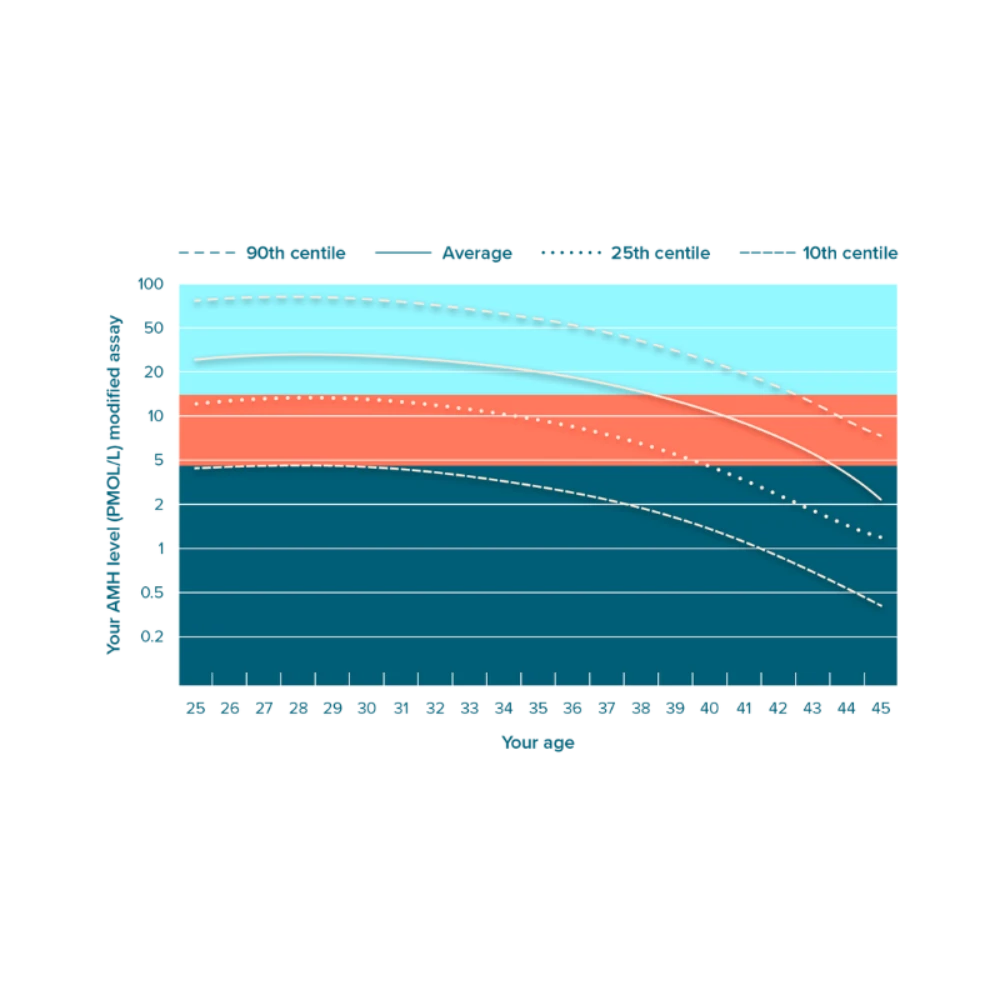
AMH levels naturally vary between individuals, even among women of the same age. Instead of comparing your result with one fixed number, fertility specialists compare your result with women in your age group using an AMH graph or AMH chart.
An AMH graph by age illustrates the expected range of AMH levels across different ages and helps you understand where your result falls compared with women of the same age.
The AMH graph below serves as a general educational guide to help you interpret your result.
However, an AMH test measures ovarian reserve only. It does not assess egg quality or diagnose infertility. For the most accurate interpretation, your fertility specialist will evaluate your AMH by age together with your medical history, ultrasound findings, menstrual history, and other fertility assessments before providing personalised recommendations.
How to Interpret Your AMH Graph
High AMH (Above the 90th Centile)
- Your AMH is higher than about 90% of women your age, indicating a higher than average egg reserve.
- You may produce more eggs during IVF stimulation.
- High AMH can sometimes be associated with Polyendocrine Metabolic Ovarian Syndrome (PMOS), although not everyone with a high AMH has PMOS.
Average AMH (Around the Average Line)
- Your AMH is close to the typical level for women your age.
- This indicates an average egg reserve.
- Most women fall within this range.
Low AMH (Around the 25th Centile)
- Your AMH is lower than about 75% of women your age, but is still within the normal range seen in many healthy women.
- This indicates a lower than average egg reserve.
- Pregnancy is still possible naturally or with fertility treatment.
Very Low AMH (Below the 10th Centile)
- Your AMH is lower than about 90% of women your age, placing you among the lowest 10% for ovarian reserve.
- You may produce fewer eggs during IVF treatment.
- A low AMH does not mean you cannot become pregnant, but early fertility assessment and personalised treatment planning are recommended.
What an AMH Result Cannot Tell You
While AMH is a valuable fertility marker, it is only one part of a comprehensive fertility assessment.
Your AMH result cannot determine:
- whether you can conceive naturally.
- the quality of your eggs.
- the exact time remaining until menopause.
- your chances of IVF success on its own.
- whether fertility treatment is necessary.
Instead, your fertility specialist will interpret your AMH result together with your complete reproductive profile to provide a clearer understanding of your fertility health.
Can You Get Pregnant with Low AMH Levels?
Yes. A low AMH level does not automatically mean pregnancy is impossible.
This is one of the most common misconceptions about fertility testing.
While a low AMH level indicates fewer remaining eggs, it does not directly measure egg quality or determine whether a woman can conceive.
Many women with lower AMH levels may still:
- conceive naturally.
- respond well to fertility treatment.
- achieve successful IVF outcomes depending on their overall fertility profile.
Age remains one of the most important fertility factors because egg quality naturally declines over time.
For example:
- a younger woman with low AMH may still have good quality eggs.
- an older woman with AMH levels within the expected range for her age may still experience age related fertility challenges.
This is why our fertility specialists assess AMH alongside other important fertility factors, including:
- menstrual history.
- transvaginal ultrasound scan (TVS) findings.
- husband's sperm health.
- medical history.
- previous pregnancies.
- overall reproductive health.
This comprehensive approach allows us to develop a personalised fertility plan based on each patient's individual circumstances.
When Should You Consider an AMH Test?
An AMH test may be recommended if you:
- have been trying to conceive without success.
- are planning to delay pregnancy.
- have irregular menstrual cycles.
- have a family history of early menopause.
- are considering egg freezing.
- are preparing for IVF treatment.
- want to better understand your fertility health.
One advantage of AMH testing is that the hormone level remains relatively stable throughout the menstrual cycle, meaning the blood test can usually be performed on any day of your cycle.
What Do Your AMH Levels Mean for Your Fertility Journey?
Understanding your AMH levels by age can provide valuable insight into your ovarian reserve and help you make informed decisions about your reproductive health.
An AMH graph or AMH chart should always be used as a guide to understand ovarian reserve trends rather than as a definitive measure of your ability to conceive.
At Sunfert, we interpret your AMH result together with your age, ultrasound findings, medical history, and other fertility assessments to provide personalised recommendations based on your unique circumstances.
If you have concerns about your fertility or would like to better understand your AMH result, our fertility specialists are here to help you explore your options and plan your next steps with confidence.
Make an appointment with our Fertility Specialist today and take the next step towards achieving your parenthood goals.
-
 Book a consultation
Dato' Dr Wong Pak Seng
Founder of Sunfert Group & Fertility Specialist- Sunfert@Bangsar South
-
 Book a consultation
Dr Eeson Sinthamoney
Group Medical Director & Fertility Specialist- Sunfert@Bangsar South
-
 Book a consultation
Dr Lim Lei Jun
Medical Director (Sunfert Bangsar South) & Fertility Specialist- Sunfert@Bangsar South
-
 Book a consultation
Dr Sumithra Devi Valiapan
Consultant Obstetrician, Gynaecologist & Fertility Specialist- Sunfert@Bangsar South
-
 Book a consultation
Dr Haris Njoo Suharjono
Medical Director (Sunfert Kuching) & Fertility Specialist- Sunfert@Kuching
-
 Book a consultation
Dr Rohani Binti Effendy
Consultant Obstetrician, Gynaecologist & Fertility Specialist (Sessional)- Sunfert@Bangsar South
-
 Book a consultation
Dr Chong Jie Wen
Consultant Obstetrician, Gynaecologist & Fertility Specialist (Sessional)- Sunfert@Ipoh
-
 Book a consultation
Dr Evelyn Pang Mei Foong
Obstetrics, Gynaecology & Fertility Specialist- Sunfert@Seremban
What is a normal AMH level by age?
There is no single "normal" AMH level for every woman. Fertility specialists interpret AMH results based on your age, laboratory reference ranges, and other fertility assessments rather than relying on one universal value.
Can AMH levels improve naturally?
AMH levels generally decline over time as ovarian reserve decreases. Although maintaining a healthy lifestyle supports overall reproductive health, significant increases in AMH levels are uncommon.
Does low AMH mean I need IVF?
Not necessarily. A low AMH level does not automatically mean IVF is required. Treatment recommendations depend on many factors, including your age, ovarian reserve, sperm health, reproductive history, and fertility goals.
Is AMH testing accurate?
Yes. AMH is considered a reliable marker for assessing ovarian reserve. However, it should always be interpreted alongside other fertility assessments, such as ultrasound findings and medical history, to provide a more complete understanding of your fertility health.